Hello Copenhagen Day 2!
This day was dedicated to Ørestad, a development in the south of Copenhagen. This major urban expansion scheme started in 1994, where a masterplanning competition was held, the outcome diving the space into four parts; Ørestad Nord, Amager Faelled District, Ørestad City and Ørestad Syd. It features lots of works by well-known architects, the first building being finished in 2001.
When complete, 20,000 people will live there, 80,000 will work there and 20,000 will study there. Very ambitious!
We began the day in Ørestad Syd, making our way there by tram from the Central Station.
The first building we came across when arriving at Ørestad Syd tram station was this intriguing car park. Not sure what it is called, but I'm assuming it provides parking to the developments seen behind.
The development furthest away from the centre of town is BIG's 8 Tallet, finished in 2010. This was the first of BIG's buildings I got to experience on the trip, not realizing how well known he is in the architecture world.
From 8 Tallet, we walked toward Ørestad Nord, stopping at various places along the way.
This building below is Ørestad Gymnasium by 3XN, completed in 2006. This isn't any ordinary school, the interior being mostly open plan, aiming to achieve a more dynamic study environment.
Next up are BIG's 2 other developments in the Ørestad area. Firstly, the VM Houses.
Hidden behind the VM Houses is the Mountain Dwelling. My first impression of this building was that it was completely abstract. Someone in our group said, 'I don't like it...' and to that the tutor replied, 'It's fine if you don't like it, as long as you understand it beforehand.' This made my outlook on it change somewhat, wanting to find out more about it, to prove to myself why I found it so odd. After doing an essay assignment on it, I found myself falling in love with the building, and BIG's architectural aspirations.
Underneath the box-like living accomodation is the parking, hidden by the metal mountain screen.
On the opposite facade is the 'natural' mountain, where all apartments have a balcony overlooking the field beyond.
I wasn't sure what this next building was when we went there, but now I think it is the Concert Hall. Though images show it lit up blue at night, because we went there during the day, I can't remember what the exterior looked like! However the interior bounces light off of the concrete, the glass acting as shelter from the outside, with the concrete holding the purpose.
Outside the Concert Hall, materials have been used to cleverly hide the services of the building.
Below is the IT University by Henning Larsen. If this was my university, I would want to be there all the time! The small pods are used as study areas, overlooking the light filled circulation space.
The Tietgen Students' Hall provides accommodation for the surrounding university. The contrast between this and UK student halls is immense!
After what seemed like an hour or 2, we found the Opera House, which is completely out of the way from the rest of the city, or so it seemed. The quickest and easiest way to get there would be by the boat, which you can use the tram tickets on, and runs right down the centre of the city.
Though not the best weather on the day, we got to experience standing underneath that massive cantilevering roof!!
It seems like hiding services is a common attribute in Danish architecture, seen previously in the Copenhagen Concert Hall.
That night, we ate at an Italian pizza restaurant round the corner from Generator Hostel. As good as the pizza was, I don't think the owner understood a lot of Danish, let alone English, so there was a lot of menu pointing and trying to communicate in weird accents!
Stay tuned for day 3, featuring more walking and more architecture!


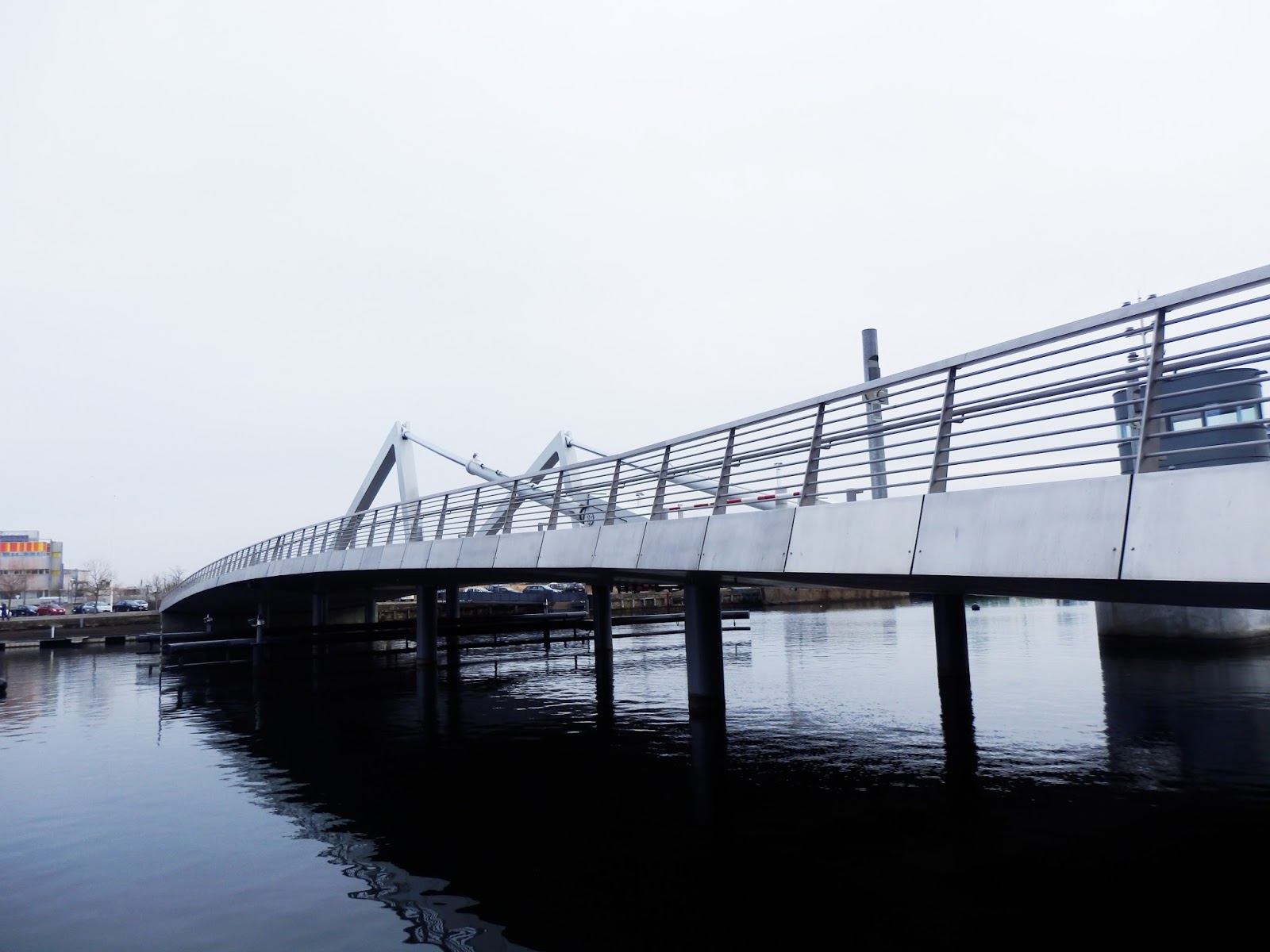
 The view looking West from Teglholmen.